
AI/ML-Assisted Computational Materials Design
Building data-aware molecular design workflows that use machine learning, structure-property relationships, and predictive descriptors to accelerate materials discovery.
Research
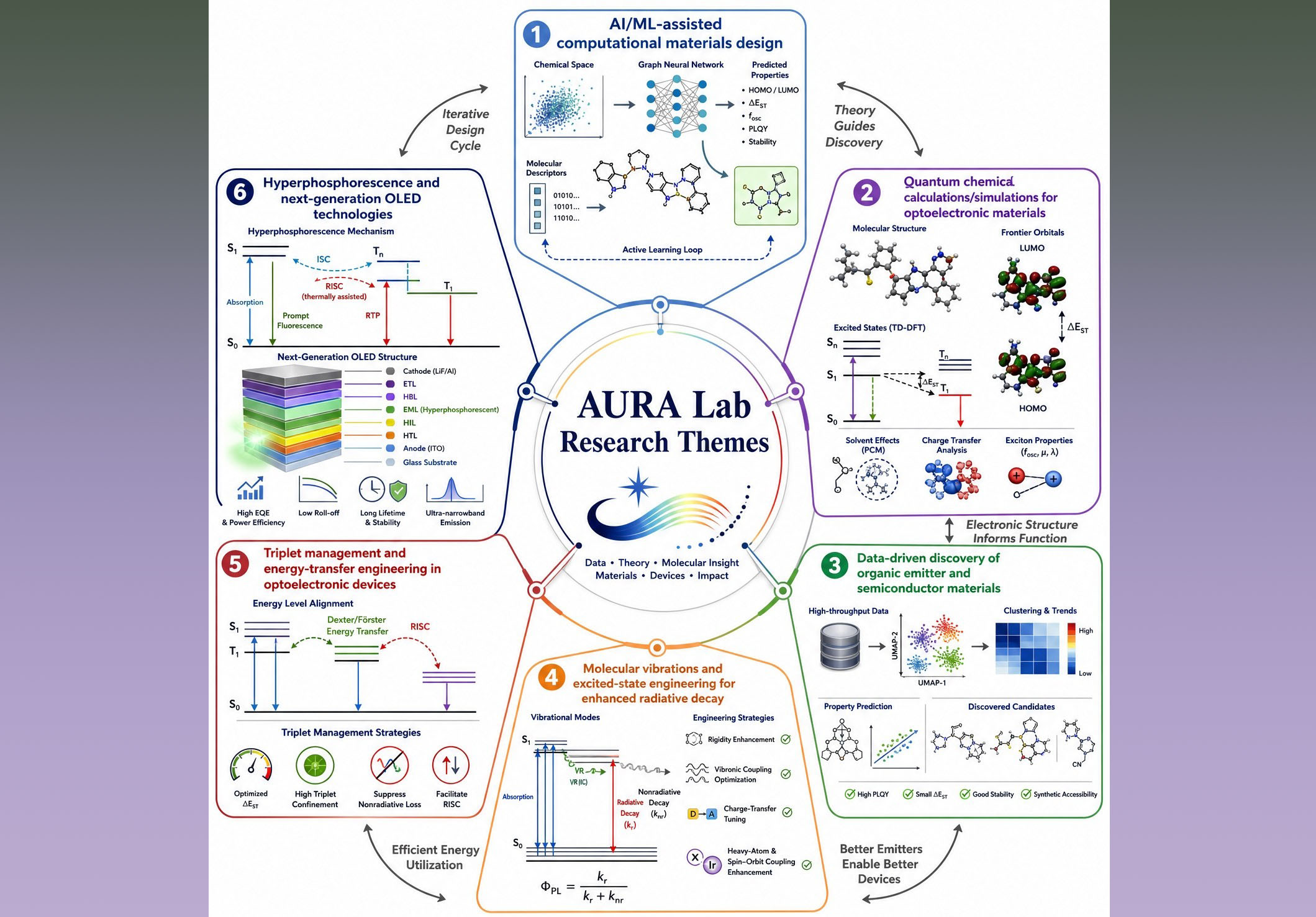
AURA Lab combines computational design, molecular simulations, photophysical insight, and device-oriented analysis to discover efficient organic emitters and semiconductor materials for next-generation optoelectronics.
Current programme
Building data-aware molecular design workflows that use machine learning, structure-property relationships, and predictive descriptors to accelerate materials discovery.
Using quantum chemistry to model excited states, charge transfer, frontier orbitals, spin dynamics, and emissive pathways in candidate optoelectronic systems.
Combining curated datasets, screening logic, and computational filtering to identify promising emitters and semiconductor platforms with improved performance windows.
Controlling vibrational coupling, excited-state relaxation, and molecular rigidity to enhance radiative efficiency and suppress wasteful decay channels.
Designing triplet-harvesting, host-guest, and donor-acceptor frameworks that improve energy transfer, exciton utilization, and operational stability.
Developing material strategies for hyperphosphorescent OLEDs and advanced emissive architectures with high efficiency, strong colour purity, and low roll-off.
Methods & capabilities
Application pathways
Featured direction
A major direction of the group is the rational design of emissive systems for advanced OLED technologies. By coupling computational screening with excited-state engineering and triplet management strategies, we aim to identify material combinations that improve external quantum efficiency, reduce roll-off, and enable more robust next-generation display and lighting platforms.
View related publications ›